Stowe spent $20,000 on an STR Impact Study. Results don’t justify new restrictions.
The central conclusion of Stowe’s commissioned economic impact study is that Stowe’s short-term rental (STR) market creates substantial economic value with some measurable community costs, but the data do not support the claim that STR growth is the cause of declining homestead declarations or of Stowe’s housing shortage.
The Stowe Selectboard heard a presentation of the draft report on August 25, 2026. Watch their reaction to the findings.
Summary of the Study’s Conclusions
1. STR growth has not been shown to cause Stowe’s decline in homesteads
The study’s statewide analysis of 175 Vermont towns found:
A very weak correlation between STR listings and homestead filings: r = 0.099
No statistical significance: p = 0.193
A separate STR-intensity analysis explained only 1.8% of the variation in homestead filings
The authors conclude that Stowe’s increase in STRs and decline in homestead declarations appear to be moving independently. This directly undercuts an argument that restricting STR eligibility to homestead properties is an evidence-based housing solution. The study does not find that STRs caused the homestead decline.
2. Homestead declarations are not a reliable measure of residency
The report finds that people can reside in properties classified as non-homestead, particularly when properties are held in trusts or have other ownership structures. Voter-registration, voting, mailing-address, and trust data suggest that a meaningful number of Stowe residents live in non-homestead properties.
The authors estimate that approximately 257 to 364 non-homestead parcels may be occupied by Stowe residents. That is considerably more than the 65 properties that left the homestead inventory between 2018 and 2025.
Therefore, the decline in homestead declarations should not automatically be interpreted as an equivalent loss of Stowe residents.
3. Most registered STRs are not operating like high-return commercial investments
The report calculates an average return of approximately 3.7% across active STRs, below the investment returns generally expected from commercial lodging.
Using an 8% cap-rate threshold, it classifies:
94 owners, or 13%, as investor owners
621 owners, or 87%, as non-investors
Investor owners control 116 of the 921 registered STR units in the non-exempt working database
This suggests that Stowe has a relatively small high-performing investor segment within a much larger group of lower-return and inactive STR owners.
That supports distinguishing between commercial investor activity and personal or supplemental rental activity instead of regulating every STR as though it were a commercial hotel.
4. Some STRs overlap with attainable housing, but conversion is uncertain
The study identifies:
28 registered investor STR units valued at or below approximately $380,000, the threshold for households earning 120% of the area median income
74 investor units at or below approximately $570,000, its threshold for households earning 180% of the area median income
Most of the lower-priced overlap consists of condominiums.
This shows that some investor STRs occupy housing that higher-income local households might potentially purchase. It does not demonstrate that eliminating STR use would result in those properties becoming primary residences or long-term rentals. The report expressly says that the owner's intentions would need to be determined through interviews.
A reasonable conclusion is that the housing overlap is real but limited and concentrated. It may justify narrowly targeted analysis of investor properties, but it does not establish that broad restrictions on all STRs would materially increase the supply of workforce housing.
5. STRs and hotels serve overlapping but substantially different markets
The report finds:
Average STR occupancy of approximately 31.2%
Average hotel occupancy of approximately 54%
Hotels capture a larger share of available-room demand
Most direct competition occurs between comparable products, such as private-entry studios, suites, and units with kitchens
Single-family STRs accommodate groups and visitors seeking space, privacy, and residential amenities that traditional hotel rooms typically lack.
The evidence does not support treating every STR as a “mini-hotel.” STRs and hotels are partial substitutes, not interchangeable products.
6. STR visitors make a major contribution to the regional economy
The study attributes the following to Stowe STR activity in 2025:
$27 million in accommodation revenue
Approximately $42.8 million in direct visitor spending
418 direct jobs
$18.1 million in direct wages
An additional 251 indirect and induced jobs
An additional $22.4 million in indirect and induced wages
This is strong evidence that STRs support more than property owners. They bring spending to restaurants, retailers, recreation providers, cleaners, maintenance companies, transportation providers, and other local businesses.
Policies that substantially reduce STR availability could therefore produce economic consequences beyond the STR sector itself.
7. STR activity also creates measurable service and environmental impacts
The study estimates that active STRs:
Use more energy and water per occupied night than conventional residences
Account for approximately 16% of estimated residential water consumption
Generate an estimated 165 to 504 associated vehicles per day, with a midpoint of 334
Are 2.04 times more likely to have at least one EMS incident
Are 2.48 times more likely to have at least one fire incident
These findings support reasonable measures addressing safety, occupancy, water and wastewater capacity, parking, traffic, and emergency preparedness.
However, these results do not necessarily support restrictions on who may own or operate an STR. They point more directly toward performance-based standards and mitigation.
Important Methodological Cautions
Several of the study’s headline claims are less certain than they initially appear.
“Non-investor” does not necessarily mean recreational owner. The report identifies investors using an 8% cap rate threshold. Owners below that threshold may still have purchased for investment purposes but obtained lower returns. The report did not survey owners about their motivations.
The housing thresholds are constructed by the consultants. They rejected the prior Housing Needs Assessment’s approximately $267,000 figure as “unreasonably low” and substituted approximately $380,000 at 120% AMI and $570,000 at 180% AMI.
The affordability model assumes no condominium fees. Because most lower-priced units are condos, excluding HOA fees may overstate their affordability.
Assessed value is only a proxy for purchase price. It does not establish that a property is listed, available, suitable, or financeable for a workforce household.
The homestead regression is cross-sectional. It compares towns but does not fully control for tourism intensity, housing construction, household income, demographic changes, second-home demand, or other variables. It finds no statistical relationship, but it cannot conclusively prove that STRs have no housing effect under any circumstances.
Environmental estimates rely heavily on assumptions. Energy and water consumption are modeled using hotel and residential standards rather than actual property-level utility data.
The transportation calculation applies hotel trip-generation assumptions to STR bedrooms. The resulting range is extremely wide, so it is better treated as a planning estimate than a measured impact.
The emergency services comparison needs additional controls. STRs may differ from other properties in size, occupancy, location, assessed value, visitor activity, and reporting behavior. The report shows an association, not necessarily that STR status caused the additional calls.
The economic model assumes Stowe STR visitors follow average Lamoille County spending patterns. The estimates are reasonable contribution-model outputs, but they are not direct surveys of what individual STR guests spent.
Does the data justify new STR restrictions?
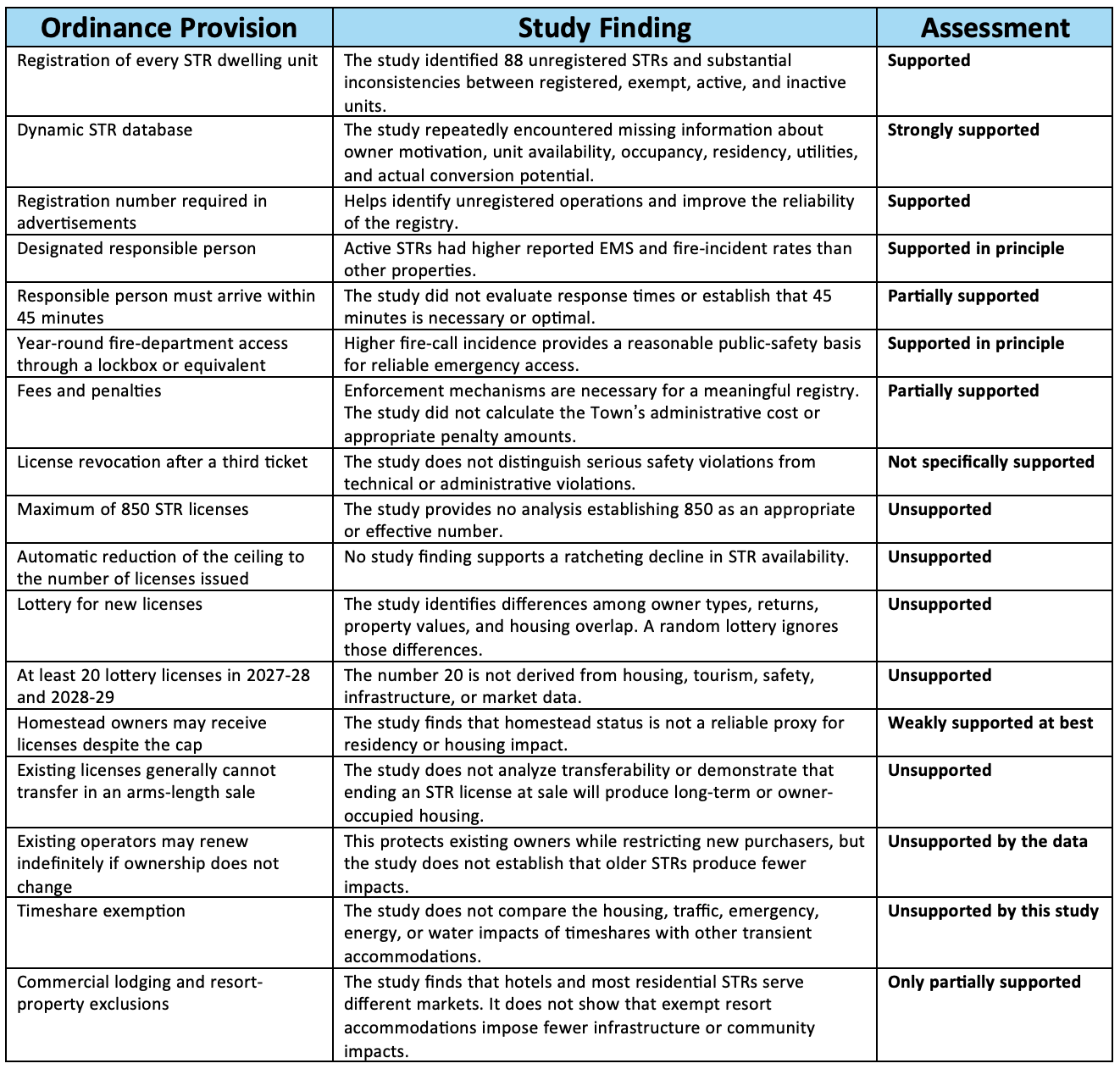
No. The study supports the ordinance’s registration, emergency-access, responsible-person, data-collection, and enforcement provisions. It does not provide a strong evidentiary basis for the ordinance’s central supply-control provisions: the 850-license ceiling, automatic attrition, nontransferability upon sale, homestead preference, or random allocation of new licenses. In fact, several of the study’s principal findings cut against the ordinance’s stated housing rationale.
The study supports regulation aimed at demonstrated impacts, including fire safety, occupancy, wastewater, parking, traffic, and responsible operations. It also supports closer monitoring of the relatively small investor segment that overlaps with attainable housing.
It does not provide evidence for a blanket policy limiting future STRs to homestead properties. Such a policy would reach far beyond the investor units identified as potentially affecting workforce housing, including seasonal homeowners, resident-owned rentals, low-activity properties, and units that may never enter the long-term housing market.
The clearest evidence-based policy direction is targeted regulation, transparent data collection, and enforcement of safety and community standards, rather than ownership or residency restrictions applied to the entire STR sector.
This can be explained by the timing issue: the ordinance was adopted in July 2026, while the economic-impact study is a draft dated August 2026. The adopted regulations, therefore, were not informed by the study’s findings.
The ordinance’s housing goal conflicts with findings
The ordinance states that its purpose includes:
Increasing long-term housing availability
Preventing conversion of owner-occupied and long-term rental units
Minimizing STR investment and speculation
Increasing housing for local workers
Those are legitimate policy objectives, but the study does not demonstrate that the ordinance’s chosen mechanisms will accomplish them.
No demonstrated causal connection to declining homesteads.
The study’s statewide regression found essentially no relationship between STR listings and homestead filings:
Correlation: 0.099
P-value: 0.193
Not statistically significant
Its STR-intensity analysis explained only about 1.8% of the variation in homestead filings.
The study concludes that Stowe’s increasing STR activity and declining homestead declarations appear to be moving independently. That substantially weakens the claim that reducing the number of STR licenses will reverse Stowe’s homestead trend.
Homestead status is a poor eligibility standard.
The ordinance gives special treatment to owners whose properties qualify as homesteads or can otherwise demonstrate primary residency.
But the study finds that:
A meaningful number of Stowe residents live in non-homestead properties.
Trust ownership can prevent a resident’s property from receiving conventional homestead treatment.
Voter and mailing-address data suggest approximately 257 to 364 non-homestead parcels may be occupied by Stowe residents.
Declining homestead filings do not necessarily represent the loss of an equal number of residents.
Although the ordinance provides a trust exception based on voter registration, its broader reliance on homestead classification still does not correspond neatly with actual residency, housing availability, or community impact.
The study identifies a much smaller investor segment than the ordinance regulates.
Using its chosen 8% cap-rate threshold, the study classifies:
94 of 715 owners as investors
116 of 921 registered units as investor units
Approximately 13% of owners and units as belonging to the investor category
The ordinance’s cap, attrition, and nontransferability provisions apply much more broadly. They affect low-return rentals, seasonal homes, individually owned properties, inactive registrations, and properties with no demonstrated connection to workforce-housing displacement.
Even accepting the study’s investor methodology, the ordinance is not narrowly tailored to the segment the study identifies as most likely to be motivated by profit.
Conversion to long-term housing is speculative.
The study identifies some investor units within its workforce-attainability thresholds:
28 investor units valued at or below approximately $380,000
74 investor units valued at or below approximately $570,000
But it expressly acknowledges that it does not know what owners would do if STR use ended. They might:
Keep the property as a private second home
Sell it to another recreational owner
Leave it vacant for part of the year
Convert it to a long-term rental
Sell it to a resident household
The ordinance assumes attrition will improve housing availability, but the study does not establish that chain of events.
The analysis also excludes condominium fees from its affordability model, even though most of the lower-priced overlap consists of condos. That may overstate how attainable those properties are to local households.
The 850-license cap is not supported by the study.
The study contains several different inventory measures:
1,306 registered STRs before exclusions
383 exempt units
921 units in the non-exempt working database
649 active units
528 active parcels generating revenue
Nothing in the study explains why 850 represents the correct balance among housing, tourism demand, economic activity, emergency services, infrastructure, and property use.
The 850 figure is:
Not tied to a percentage of Stowe’s housing stock
Not tied to the number of investor STRs
Not tied to the number of potentially attainable units
Not tied to emergency-call volume
Not tied to neighborhood distribution
Not tied to water or energy capacity
Not tied to documented visitor demand
Not tied to an economic-impact threshold
It is therefore a policy choice, not a data-derived result.
The automatic reduction provision is even less supported. If only 800 licenses happen to be issued in a year, the ordinance can reduce the future ceiling to 800 unless the Selectboard intervenes. That creates permanent attrition based on administrative participation rather than evidence of housing need or community impact.
Nontransferability is particularly disconnected from the evidence.
The ordinance generally ends an STR license when a property is sold through an arms-length transaction. It allows limited transfers among relatives, trusts, spouses, and certain heirs.
The study does not evaluate:
How STR authorization affects property value
How many licensed properties sell annually
Who is likely to purchase them
Whether those buyers would become full-time residents
Whether the properties are suitable or affordable for workers
Whether nontransferability will increase private second-home use
Whether it will shift demand toward exempt resort properties
The effect on small property-management businesses and local vendors
Nontransferability may gradually reduce neighborhood STR inventory, but the study does not show that it will create workforce housing. It could instead transfer lodging demand and investment value toward resort properties and commercial lodging establishments that remain exempt.
The public-safety provisions have the strongest evidentiary support.
The study found that active STR properties were:
2.04 times more likely to have at least one EMS incident
2.48 times more likely to have at least one fire incident
Those results reasonably support:
Accurate emergency contacts
A designated responsible person
Reliable first-responder access
Enforceable registration
Clear identification of active STRs
Coordination with the Fire and Police Departments
However, the incident analysis does not control for property size, occupancy, visitor volume, location, age, or frequency of use. It supports precautionary requirements, but it does not establish that every STR presents twice the inherent risk of every other home. The study also does not establish that a 45-minute in-person response is the appropriate standard. That time requirement appears to be a policy judgment.
The study supports impact management, not ownership restrictions.
The study identifies real impacts involving:
Fire and EMS calls
Energy consumption
Water use
Traffic and parking
Unregistered operators
A limited group of high-return investor properties
Some overlap with units attainable to higher-income workforce households
A regulation closely tied to those findings would emphasize:
Universal registration and platform identification
Fire and life-safety compliance
Emergency access and responsible contacts
Occupancy and parking limits based on property capacity
Noise and nuisance enforcement
Wastewater and water-capacity compliance
Transparent reporting of nights booked and rental activity
Differentiation between low-activity personal use and commercial investor activity
Periodic measurement of actual housing conversions
Review of neighborhood-level impacts
Enforcement against demonstrated violations
The ordinance instead uses ownership transfer, homestead status, a fixed numerical ceiling, and random lotteries as its principal supply controls. Those mechanisms are not closely connected to the problems the study actually found.
Overall Assessment: Stowe’s STR Law is Not Backed by Data
The ordinance is best understood as two different regulatory programs combined:
A registration and public-safety program, which is substantially supported by the study.
A long-term STR attrition program, which is not supported by a demonstrated causal relationship between STRs and Stowe’s housing trends.
The study gives Stowe a reasonable basis to register STRs, require emergency contacts and access, collect data, and enforce safety and operating standards—which it did with the original version of its STR Ordinance. The new amendments passed in July 2026 are not deemed to be effective policies for achieving the town’s stated goal and purpose of the ordinance. Unintended consequences are an expected result of policies not backed by data.
Where does that leave Stowe homeowners & businesses?
Stowe homeowners are left with greater uncertainty, fewer options, and potentially diminished property values. Existing operators may continue renting, but the ordinance makes that ability increasingly dependent on ownership status and property classification, limiting what future buyers can do with the same home. Meanwhile, local property managers, cleaners, contractors, restaurants, retailers, and tourism businesses face the gradual loss of independently operated rentals that generate visitor spending throughout the community.
The economic impact study confirms that STRs are an important part of Stowe’s tourism economy, while providing little evidence that eliminating them through attrition will meaningfully improve housing affordability. Stowe has therefore adopted a policy with measurable economic risks but unproven housing benefits. The result is not a balanced solution. It places the burden on homeowners and small businesses while benefiting hotels and resorts rather than renters.
Homeowners should remain fully compliant, keep their STR registrations current, and maintain clear records of their rental activity. Property owners and local businesses should also document any financial harm resulting from the ordinance, including lost bookings, reduced revenue, declining property values, or changes in employment and local spending.
Residents can continue attending town meetings and pressing elected officials to rescind the amendments, particularly the restrictions that reduce property rights and disadvantage independently owned rentals. They should also pay close attention to local elections. New leadership can bring new perspectives and reconsider policies that are not producing measurable benefits.
Finally, join VTSTRA. A unified voice is a strong voice, and growing our membership gives Stowe homeowners and businesses greater influence, better coordination, and stronger representation when decisions affecting their properties and livelihoods are made.
Disclaimer: This is a policy and evidence assessment, not a legal conclusion about the ordinance’s validity.
Read: Stowe STR Ordinance, as adopted July 2026
Read: Stowe Economic Impact Study, August Draft Version