Short-term rentals (STRs) are often at the center of debates over housing and tourism. But many of the assumptions driving those conversations don’t match how the industry actually works.
Here are 5 things people often misunderstand about vacation rentals (aka STRs).
1. “Most STRs are owned by large corporations.”
A dominant narrative is that the vacation rental industry is largely driven by big investors buying up housing. In reality, most short-term rentals are owned by individual homeowners.
In Vermont, about 80% of short-term rental owners operate just one or two listings, and roughly half of Vermont STR owners are full-time Vermont residents, according to intel from Keydata Dashboard and Airbnb.
Many STRs are owned by retirees or “snowbirds”, families renting their vacation home, or locals using rental income to offset rising costs of homeownership in Vermont.
Platforms like Airbnb (launched in 2008) and Vrbo (launched in 1995) made it easier for individuals to participate in hospitality without owning a hotel. This has allowed ownership to be widely distributed, not concentrated. Another reality check is the cost of development in Vermont. Investor-backed entities require major ROIs that Vermont can’t deliver. There’s no economic incentive for STR investment in Vermont. No evidence has surfaced to show any large-scale corporate investment in STR homes in Vermont.
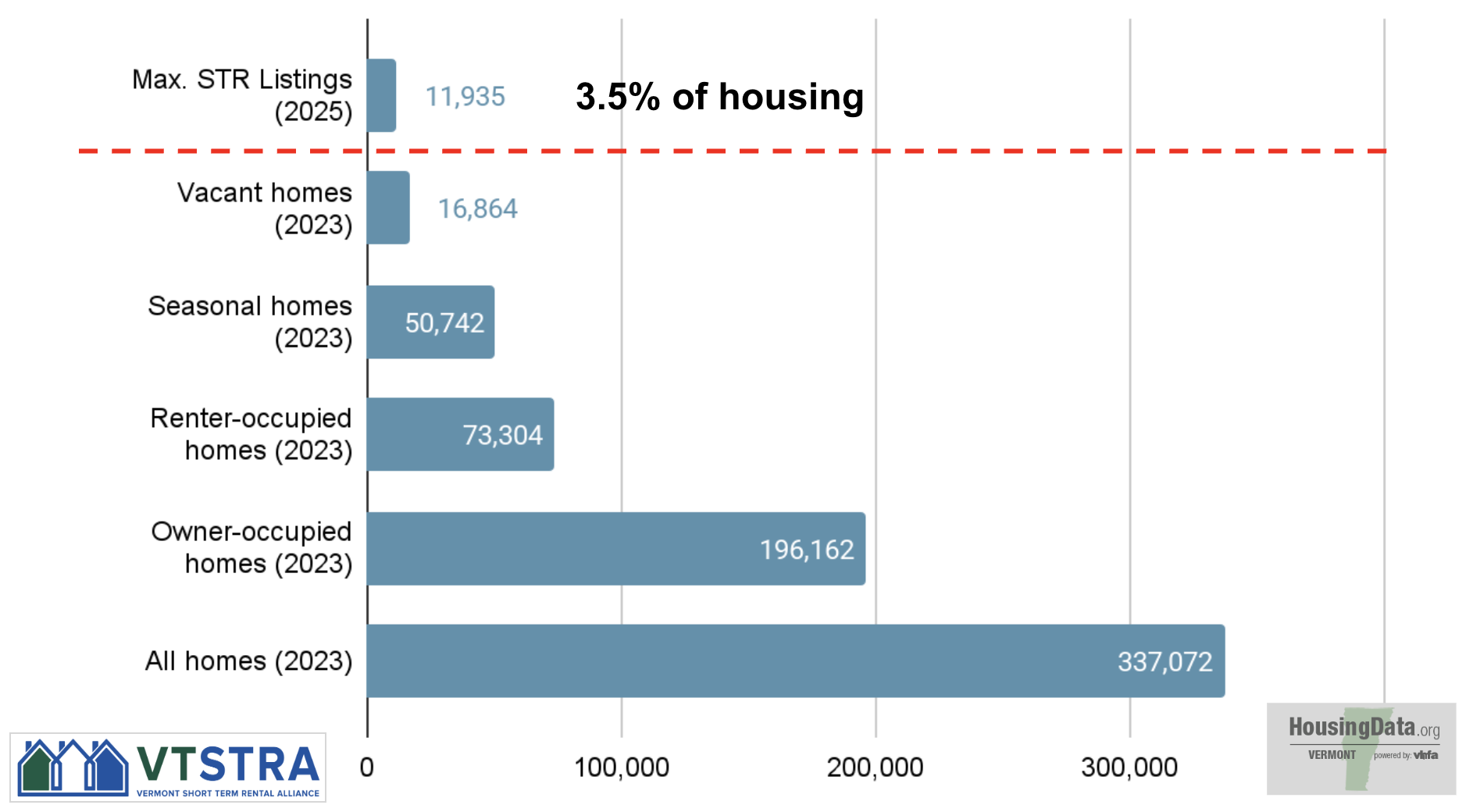
Peak “whole-home” STR listing represent 3-4% of Vermont’s housing stock. Includes owner-occupied homes and ADUs.
2. “STRs could easily become long-term housing.”
A common assumption is that if short-term rentals were restricted or banned, those homes would automatically become long-term housing. In reality, most short-term rentals were never part of the traditional year-round housing market.
In Vermont:
Short-term rentals represent about 3% of the state’s housing stock, but over 60% of visitor capacity.
Around 90% of STR properties are occupied by their owners during the year.
Many are seasonal homes in resort areas, ski communities, or rural locations where year-round rental demand is limited. About a third were purpose-built ADUs or unique accommodations designed by the owner for STR use from the outset.
While some STRs serve as flexible “medium-term” housing—up to 80% are occasionally used for monthly furnished rentals, hosting traveling professionals, construction crews, or families relocating to Vermont—the majority would not be available as long-term rentals.
Furthermore, the average market value of a typical vacation home is not always equivalent to “affordable” housing. In Maine, the Housing Authority found that only a third of Maine’s vacation home rentals would be considered “naturally occurring affordable housing”. If we extrapolate Maine’s data to Vermont—one-third of 3 percent—it could suggest that up to 1% of Vermont’s “naturally occurring affordable housing” is being used as a short-term rental for part of the year.
Housing is a complex issue. Short-term rentals are one small piece of a much larger system that includes zoning, permitting, local opposition, construction & labor costs, infrastructure limits, demographic shifts, and fundamental private property rights.
3. “STRs are a drain on communities.”
Short-term rentals are often blamed for a loss of community character and community resources. In reality, they are often an integral part of a community’s local economy that attracts and serves local residents.
In Vermont, STR accommodations:
generate about $650 million in spending at local businesses each year;
support roughly 6,000 jobs, including cleaning, maintenance, landscaping, and property management;
produced more than $54 million in Meals and Rooms Tax revenue in 2023—funding education & roads.
Overall, short-term rentals are estimated to drive over $1 billion in annual economic activity in Vermont.
Guests staying in vacation homes typically spread their spending across the community, visiting local restaurants, cafes, farmstands, ski areas, shops, grocery stores, gas stations and more. 60% of STRs are located in towns without a hotel. In Vermont’s rural destinations, short-term rentals are often the primary lodging infrastructure for visitors and tourism economic activity.
For many Vermont towns, STRs help keep communities vibrant so that residents can enjoy year-round services and amenities.
4. “STRs and second homes are the same.”
The term “short-term rental” is often used as if it describes a single type of property, typically a single-family home. In reality, any type of dwelling unit can operate as a short-term rental, including:
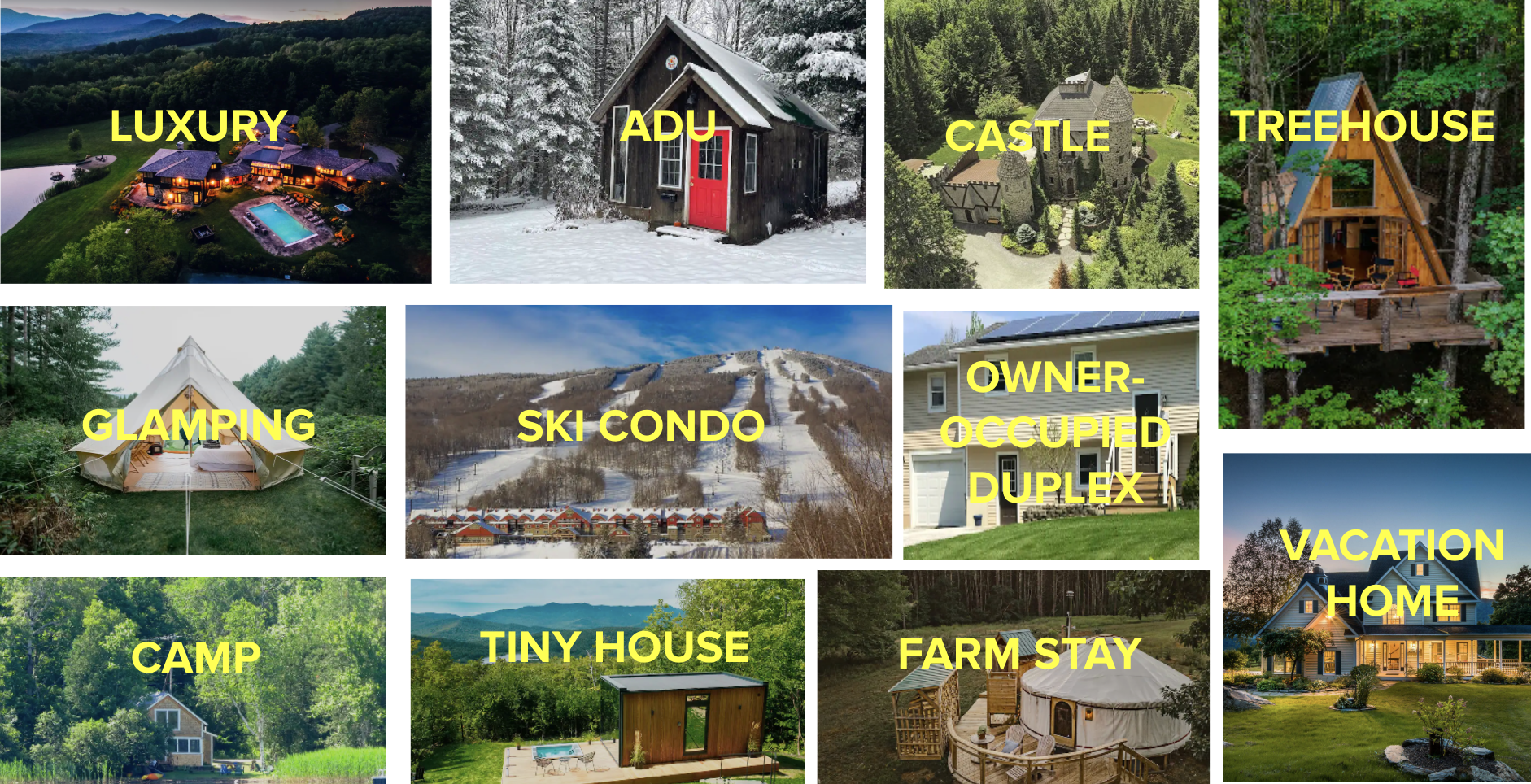
Active rental listings on Airbnb in Vermont (as of 2024) classified as “whole-home” rentals.
a spare room in a homeowner’s house
a detached mother-in-law or accessory dwelling unit (ADU) on a homestead property
a three-season camp
a yurt offered as a farmstay
a condo or townhouse at ski resort
These are very different business models and use patterns. Only 40% of Vermont’s STRs are single-family homes—and that includes ADUs on the owner’s property.
Yet many policy proposals treat STRs and second homes as the same. When that happens, rules designed for one type of property can unintentionally affect many others.
Understanding these differences is important for creating policies that address real concerns without creating unnecessary side effects.
5. “Restricting STRs will quickly fix housing problems.”
Communities sometimes adopt strict limits on short-term rentals, expecting housing supply to increase quickly. But the outcomes are often more complicated.
Research and housing data across multiple markets have shown that many STR properties simply return to private second-home use rather than entering the long-term rental market. In tourism regions, especially, owners often choose to keep the home for personal use rather than rent it.
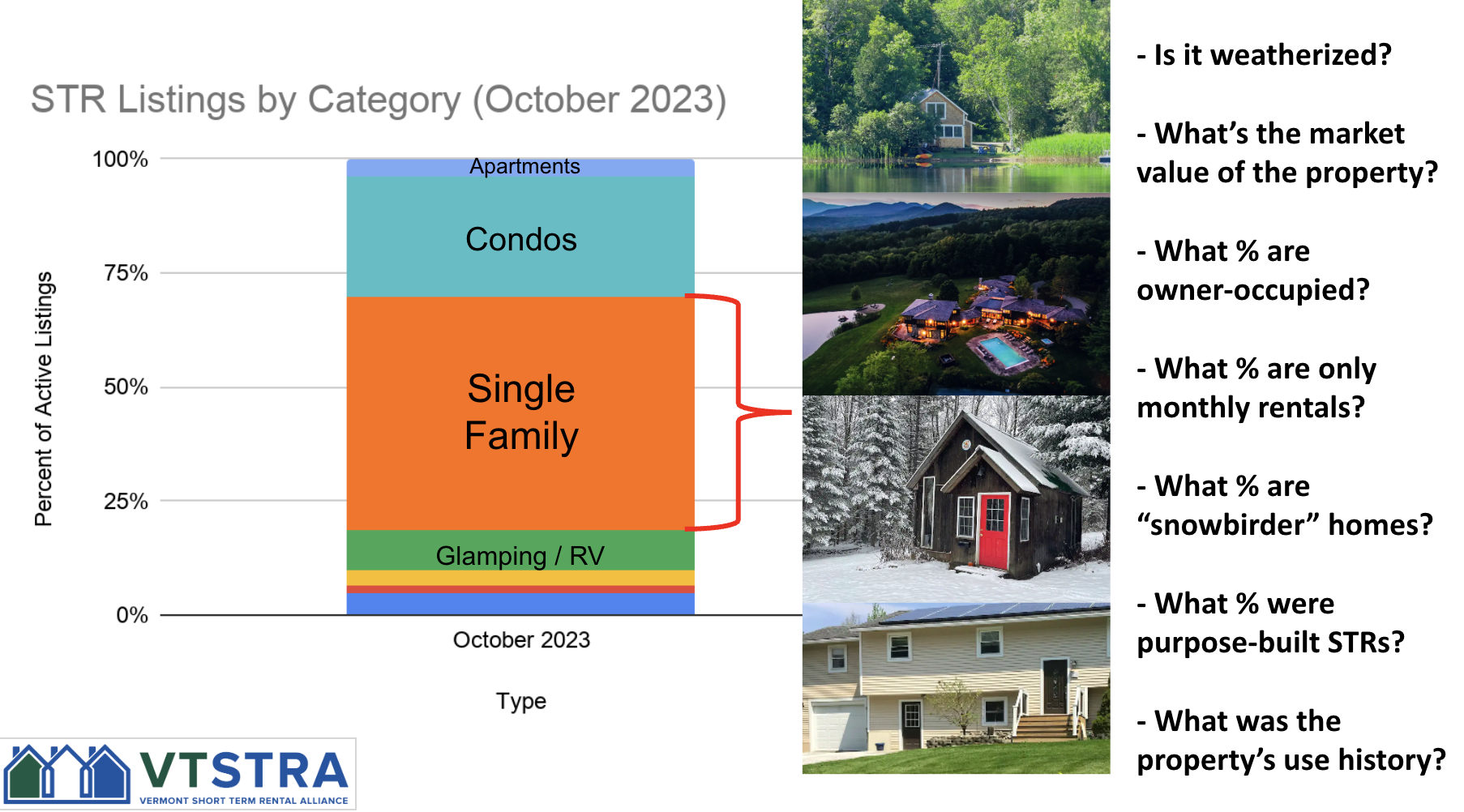
Many important questions remain unanswered, leaving huge data gaps and uncertainty on housing impacts.
At the same time, restricting short-term rentals can have unintended consequences:
Reduced tourism capacity in areas without hotels (aka loss of visitor spending at local businesses)
Loss of local jobs connected to property services
Declines in lodging tax revenue that support state and municipal budgets
In Vermont, short-term rentals already generate tens of millions of dollars in annual tax revenue, funding public services through the state’s Meals and Rooms Tax.
The result is that restrictions often redistribute tourism demand rather than eliminate it, while also reducing economic activity in communities that rely on visitor spending.
A more productive conversation
Short-term rentals are one part of a much larger housing and tourism ecosystem. Thoughtful policy discussions work best when they begin with accurate information about:
What type of properties are being rented short-term
How a property’s use has changed over time
How tourism impacts local economies
Which policies actually deliver desired outcomes
When communities start from shared facts, it becomes much easier to design solutions that balance housing needs, personal property rights, and a healthy local economy.